


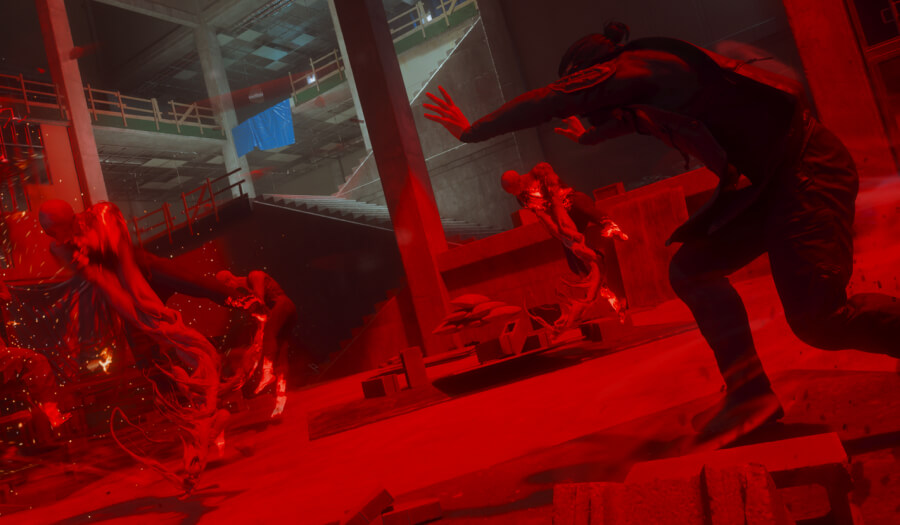
Control Resonant's combat, much like the game's world-altering perspective, flips the script for the sequel. Control was all about ranged combat, while Control Resonant focuses on melee combat.
The game leaves Jesse, the protagonist from the first game, behind; instead, we play as Dylan, her brother. This move to melee is significant because it's Remedy's first real go at a melee-focused game.
Check out our overview guide to Control Resonant for release, editions and story.
Table of Contents
- Combat Basics
- The Aberrant and Its Forms
- Aggression Fuels Power
- All Dodge, no Parry
- Powers, Status Effects and Executions
- Builds and the Gap
Combat Basics
Melee is king in Control Resonant, and if you want an idea of the inspiration, then Remedy has made it clear where it came from. Devil May Cry and PlatinumGames' Bayonetta were huge inspirations, alongside Kingdom Hearts. Those are big shoes to fill, but there is a theme, even if the look of those games doesn't match Control Resonant. The games that are inspiring Control Resonant are all about "flowy" aerial combat. That style fits with Resonant, with Remedy's brand of weird world mixing with the deliberate combat style of those it was inspired by.
The key here is that we are not getting a Dark Souls-style of heavy combat or Witcher 3's action melee. This is about style, maybe in place of some level of substance.

The Aberrant and Its Forms
Your weapon is the Aberrant, the shape-shifting armament Jesse and the Board hand to Dylan. It's his answer to Jesse's Service Weapon, except instead of morphing between gun types, it morphs between melee weapons.
You pick one of three forms at the start of the game, each pushing a different playstyle. More styles unlock as you play, but the starting three give you some idea of the style. Weapons include twin daggers, a scythe and a large axe.
The idea is that you pick an ideal form early, commit to that for a bit, then change later. You're not fully locked in, but the first Aberrant will stick with you for a while.
Note: On PS5, the DualSense adaptive triggers are used to give Dylan’s combat abilities a tactile feel. This is used to help you "feel" what Dylan is doing.
Aggression Fuels Power
"Aggression fuels power." Those are the words of Remedy's Senior Communications Manager, Miika Huttunen. The game wants you to push the fight forward, not sit back and counter.
- Hit things with the Aberrant. Landing melee attacks fills up your ability resource.
- Spend that resource on paranatural powers. These deal damage and, importantly, stun enemies.
- A stunned enemy is wide open, so you trigger an execution on them.
- Executions hand you a temporary buff to your melee damage.
- That buff rolls into your next combo, so you hit harder and refill faster.
So, as you can see, it's all about fighting on the front foot. You are the boss here, and you need to fight like one. The game rewards aggressive play, and it's a fact it pushes from the very start.

All Dodge, No Parry
If you've just come off our Dawnwalker combat guide and its directional parries, then Control Resonant has not got time for you. Here, we fight, and we fight hard.
The dodge is what gives you your defensive edge in Control Resonant, and Dylan has a very good dodge. Dylan covers loads of ground with it and gets a generous chunk of invulnerability frames. It's also an attack in its own right: with the Dodge Attack perk, you press dodge, then launch enemies and deal bonus damage.
Powers, Status Effects and Executions
Your paranatural powers are where the build variety comes into play, and you earn them by beating Resonants, the game's major boss encounters. Some Resonants even give you a branching choice, nudging you toward a particular playstyle.
The powers themselves cover a lot of ground. You might drop Mold Turrets that fight on their own and apply status effects, or throw out Seekers, telekinetic summons you can chuck at a group and detonate. Lean into them, and you can run a more tactical, summon-heavy setup instead of pure close-range pressure.
The Aberrant can also carry status effects like burn and infect, plus perks such as shorter cooldowns and extra combo ender damage. Executions chain on stunned foes too, so a well-managed fight becomes a run of finishers rather than a one-off.
Builds and the Gap
You shape all of this in the Gap, a dreamlike space tied to Dylan's psyche that you enter via a quick menu. Your build focuses on three key pillars:
- Supernatural Combat Abilities, earned by defeating Resonants.
- Weapon Forms for the Aberrant: your Primary, Secondary and Combo Ender slots.
- Talents, a passive layer that amplifies the synergy between your powers and your melee.
These builds are what set you apart from other players, giving you a build unique to you. While you are flying around dishing out crits with daggers, another player might park turrets and let executions roll. Remedy has also said you can't unlock everything in a single playthrough, and that's on purpose, so there's a reason to come back.
Keep it locked on Method's Control Resonant section when the game releases for more guides and walkthroughs.