

 Up to 84% Off VPN
Talent Builds
Preservation Evoker talent choices are different between raid and Mythic+. Flameshaper provides the best performance in both environments and is the default recommendation.
Mythic+ Flameshaper Hero Talents (Recommended for +11 and Lower)
CwbBAAAAAAAAAAAAAAAAAAAAAAAAAAAmZmZ2WmZGDjxsMDw2wAAAzYGzYMMTMmBAAAMzMTzYmZmZZMDAMmBWAbgZYCZjxmhZAmZYA
Mythic+ Flameshaper Hero Talents (Recommended for +12 and Higher)
CwbBAAAAAAAAAAAAAAAAAAAAAAAAAAAmZmZ22mZGDjxsZGw2wAAAzYGzYMMTMmBAAAMzMTzYmZmZZMDAMmBWAbgZYCZjxmhZAmZYA
Mythic+ Chronowarden Hero Talents (Viable Alternative)
CwbBAAAAAAAAAAAAAAAAAAAAAAAAAAAMzMz2yMYYmxsZGjx2wAAAzYGzYMMTMmBAAAMzMTzYmZmZZMDAAjZsxCMwMaohhFYmZGAGA
Raiding Flameshaper Hero Talents (Recommended)
CwbBAAAAAAAAAAAAAAAAAAAAAAAAAAAYmZ2MzMmxYMbGmZmthBAAmxMmBjZkZmBAAAYmZmMjZGjZmBAzYGYBsAmhJkNYzwAYmZMA
Raiding Chronowarden Hero Talents (Viable Alternative)
CwbBAAAAAAAAAAAAAAAAAAAAAAAAAAAYmZ2WmHAzYmxsZMzMzywAAAzYGzgxMyMzAAAAMzMTmxMjxMzAgBGzYhNYgZ0QDYBGzMAjB
Class Talents
The Evoker class tree is primarily about utility, survivability, and mobility, rather than raw healing throughput. It allows you to shape your toolkit around the specific demands of a dungeon or raid encounter by choosing:
- How you survive
- How you control enemies
- How you help your group handle mechanics.
Defensives
Defensive power forms one of the most important pillars of the class tree. Evokers gain access to their primary defensive, Obsidian Scales, along with several talents that enhance its effectiveness.
- Obsidian Bulwark adds a second charge
- Renewing Blaze causes you to heal back a portion of the damage taken while Obsidian Scales is active
- Foci Of Life causes Renewing Blaze to heal that damage back faster
Apart from that the talent Stretch Time turns your Deep Breath into a defensive cooldown by staggering any damage you take during it.
Utility
Another major strength of the class tree is the large amount of control and utility it provides. Evokers have access to multiple forms of crowd control, including:
- A root (Landslide)
- An AOE Stun (Terror Of The Skies)
- A knock up (Tail Swipe)
- A knockback (Wing Buffet)
- A long-duration single-target CC that can be used for skips in M+ (Sleep Walk)
In raid environments, talents such as Source Of Magic and Potent Mana allow you to further support other healers by improving their resource management.
Mobility
Mobility is another defining feature of the Evoker class tree. Abilities such as Hover, Verdant Embrace, and Rescue allow you to reposition quickly or assist teammates in dangerous situations. Many talents enhance Hover by increasing its:
- Movement speed (Tailwind),
- Duration (Extended Flight),
- Or flexibility (Aerial Mastery)
Evokers can also extend their mobility to the group through abilities like Zephyr, Time Spiral and Spatial Paradox.
Picking Talents
Start with the core talents shown below. These are the picks I consider mandatory and that you take in basically every build.
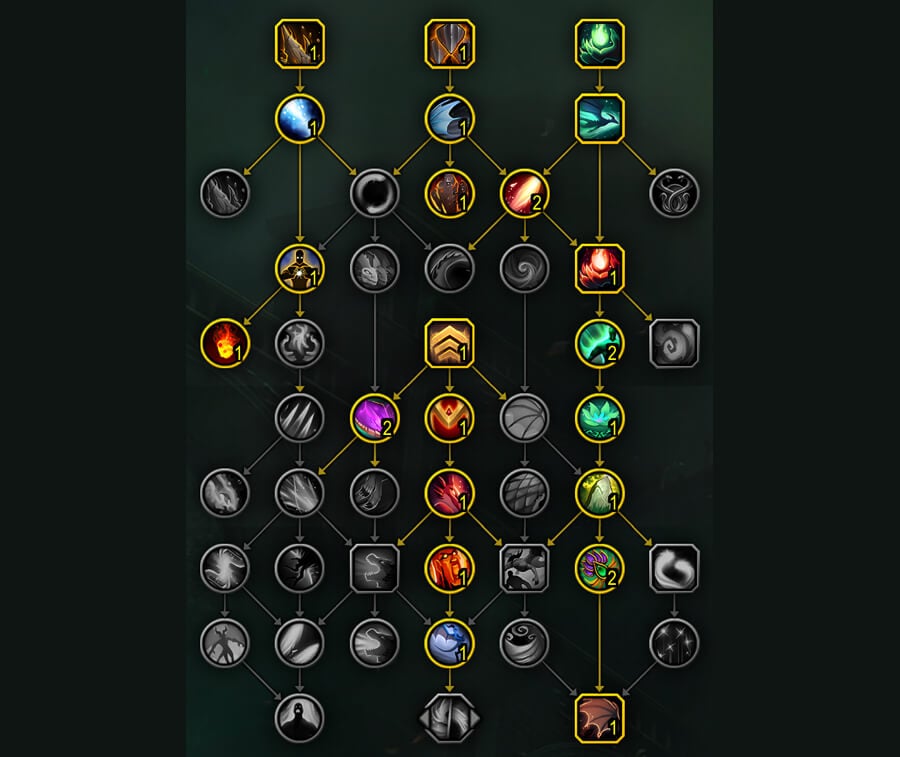
Leaping Flames is also mandatory, though the exact path into it is flexible. After locking in this core, you have 9 remaining points to spend. Use them to adapt to your own preference, the content and what your group needs.
In the raid, Source Of Magic and Potent Mana are standard picks. In Mythic+, those flex points are spent to solve specific problems: Oppressing Roar with Overawe for a soothe, Sleep Walk for skips, or Rescue if one of your teammates decides that mechanics are optional and needs to be dragged back into position..
The tree is designed to be adjusted regularly, rewarding players who adapt their choices to the content rather than locking into a single static setup.
Spec Talents
The Preservation Evoker spec tree defines how you heal. It allows you to emphasize different aspects of your kit, build distinct healing playstyles and tailor your approach to the demands of specific encounters.
Upper Section of the Tree
The upper portion of the tree is mostly fixed and forms the foundation of Preservation’s gameplay. It grants access to your core abilities, including:
This section does not offer much build choice. Its purpose is to establish the baseline tools that every Preservation build is built around.
Middle Section of the Tree
The middle section of the spec tree focuses on enhancing that core healing toolkit, letting you invest more heavily into specific parts, but not really changing the core playstyle.
The left side focuses on empowering your green spells, primarily improving Dream Breath and Emerald Blossom through increased healing, cooldown reduction, and additional interactions through talents like Unshakable and Field Of Dreams. Exhilarating Burst is also located here. It's usually weaker at the start of an expansion, but gains more value in later patches, as you get more stats from gear.
The center of the tree emphasizes empower mechanics and Essence economy through talents such as Font Of Magic and Power Nexus. This section also contains your choice between two major healing cooldowns: Dream Flight or Stasis.
The right side strengthens your bronze spells. Delay Harm and Just In Time improve Time Dilation, while Golden Hour and Grace Period enhance Reversion and Time Lord improves Echo. You also find Flow State here, which is better thought of as a damage and cooldown reduction talent, since it does not grant haste and therefore does not affect your HoTs. This is also where you gain access to Temporal Anomaly, giving you a much more efficient way to spread Echo across multiple targets and the option to reduce the cooldown of Dream Breath and Fire Breath via Nozdormu's Teachings.
Bottom Section of the Tree
The bottom section is the most build-defining part of the tree. This is where Preservation builds begin to meaningfully diverge and where your talent choices have the biggest impact on how the spec actually feels to play. In other words, this is the part of the tree where you decide what kind of Preservation Evoker you want to play.
Left Side
Spark Of Insight gives Fire Breath and Dream Breath the potential to generate Essence Burst. This is your only reliable way to get Essence Burst. Titan's Gift makes your Essence Bursts stronger, by increasing the effectiveness of the next Essence spell by 35%. This also affects effects like Golden Hour.
Renewing Breath is a straightforward Dream Breath increase, while Ouroboros improves Emerald Blossom and Fluttering Seedlings healing.
The most important choice here is the Verdant Embrace node. Wings Of Liberty gives you two charges of Verdant Embrace, which is valuable for maintaining multiple Lifebinds and enables full-party Lifebind setups with Stasis. Dream Simulacrum on the other hand removes the movement from Verdant Embrace and increases its healing, making it the safer option.
Center
Inner Flame enhances Stasis or Dream Flight by adding a throughput window where your HoTs are stronger and generate more frequent Essence Burst.
Regarding the fire talents, Life-Giver's Flame converts Fire Breaths and Deep Breaths damage into healing, which can be very strong for tank healing in high target-count situations. Lifeforce Mender increases the damage and healing of your red spells, such as Deep Breath, Fire Breath, and Living Flame, and naturally pairs well with Life-Giver's Flame. Lifespark adds a frequent proc that makes your next Living Flame instant and stronger, giving you more single-target healing.
Right Side
Energy Loop is your only active mana talent, causing Disintegrate to generate mana over its duration. Time Of Need is basically a cheat death for your group, that triggers when anyone's health falls below 30%. Timeless Magic is extremely important, extending the duration and reducing the mana cost of Reversion, Time Dilation, Echo, and Temporal Anomaly. This is especially valuable because Reversion can extend itself on crits, so the extra duration gives it more chances to extend itself.
Twin Echoes can be a very important talent. It causes Emerald Blossom to make your next Echo cast apply an additional Echo to the lowest-health ally. Compared to simply casting two manual Echoes, this effectively gives you one Emerald Blossom for free. The buff is also stackable, which lets you bank charges and quickly apply four Echoes in two globals.
Finally, Tempo Charged is a straightforward passive increase to your bronze healing and absorption.
Picking Talents
The upper section is fully fixed. Every build takes all of these talents, since they make up Preservation’s core toolkit.
In the middle section, several talents are effectively mandatory in all builds. You always take Unshakable, Spiritual Clarity, and Call Of Ysera for Dream Breath, as well as Temporal Anomaly, either with Temporal Barrier for a simpler and more forgiving option, or with Nozdormu’s Teachings for advanced players. Grace Period is also always taken, since Reversion is central to Preservation’s gameplay. Golden Hour is also standard in nearly every meta setup.
After choosing your main healing cooldown (Stasis or Dream Flight), you still need three additional points to unlock the lower section. Your three best options are:
- Exhilarating Burst for a flat healing buff
- Fluttering Seedlings for more healing with Emerald Blossom
- Flow State for more damage and cooldown reduction
- Just In Time for more utility
Once you reach the bottom section, this is where your build starts to branch based on content and preference.
On the left side, Renewing Breath is very important, both for the Dream Breath bonus and because it leads into Dream Simulacrum or Wings Of Liberty, one of which you will almost always want. Titan's Gift is also located here. Like Tempo Charged on the right side, it is mostly a passive throughput talent. Titan's Gift tends to be stronger in Mythic+, while Tempo Charged is usually better in the raid.
To reach that part of the tree, you need to path through one of three talents:
- Spark Of Insight for more Essence Burst
- Ouroboros for more Emerald Blossom healing
- Life-Giver's Flame for more healing in high target-count situations
In the center, Inner Flame is a strong talent that you can take if you want more healing throughput when you press Stasis. It can act as its own little healing cooldown. Temporal Artificer is the default raid choice if it improves Rewind alignment, but in Mythic+ it is usually only worth taking if it gives you better boss timing or an extra use. Lifeforce Mender and Lifespark are good options to increase your spot-healing.
On the right side, for mana management, Timeless Magic and Energy Loop are the main options. Energy Loop is the default whenever mana is a concern, especially in Mythic+.
If you wanna lean more into gameplay around Echo, Twin Echoes is a great talent that lets you spread Echo more efficiently. Its buff can also stack up to two times, allowing you to quickly apply four Echoes when needed. For passive throughput, Tempo Charged can be a good option, although it is generally stronger in raid than in Mythic+.
Time Of Need can be a decent Cheat-Death, but it is usually too unreliable to justify taking it in competitive content.
Apex Talents
Merithra's Blessing is Preservation’s Apex talent. It’s tuned extremely strongly and contributes a large portion of your overall healing. It has a 20% proc chance from all Essence abilities:
When it triggers, your next Reversion is upgraded into Merithra's Blessing while still keeping all normal Reversion properties. Because of that, it fully benefits from existing Reversion synergies such as Golden Hour, and it can also be copied through Echo like a normal Reversion.
Why it is Strong
When cast, Merithra's Blessing first heals its initial target and then bounces up to four additional times, prioritizing injured allies. If only a small number of players are damaged, those bounces can return to the same target, which makes it strong both for group healing and for single-target healing.
If Merithra's Blessing procs while you have no available Reversion charges, you are granted one immediately.
In addition, the second rank of the Talent adds a passive effect to Reversion that causes it to prevent a portion of incoming damage and then heal that amount back. On paper this can look fairly small, but over the course of a fight it contributes a meaningful amount of healing, especially on targets that are consistently taking damage.
What Makes it Consistent
The final rank is what turns Merithra's Blessing from a strong proc into something you can actively plan around. Dream Breath now always triggers it.
That removes the biggest weakness of the talent being tied to random procs and makes it much more reliable during ramps, Stasis setups, or predictable damage windows. This final rank also significantly increases the healing of Dream Breath.
Talent Synergies
Because Merithra's Blessing is tied to Essence usage, we are very interested in talents that improve Essence generation, reduce Essence costs, or increase Essence Burst procs.
This makes the following talents more important:
- Spark Of Insight
- Inner Flame
- Leaping Flames
- Energy Cycles and Afterimage (Chronowarden)
- Titanic Precision and Essence Well (Flameshaper)
In practice, Merithra's Blessing makes Reversion synergies and Essence economy a more central part of Preservation’s gameplay focus.
Hero Talents
Hero Talents act as a secondary specialization for Evokers, further shaping how the class plays beyond the core spec tree. As a Preservation Evoker, you choose between two Hero-Talents: Chronowarden (Focus on Bronze magic) or Flameshaper (Focus on Empower Spells).
Flameshaper
Flameshaper is the Hero Talent for Preservation players who want to lean harder into breath-based healing. Its identity revolves around stronger Dream Breath and Fire Breath interactions, steady group healing over time, and the ability to convert that sustained healing into burst healing when needed.
How it Changes your Gameplay
The biggest change is that Dream Breath becomes much more central to how you heal. Legacy Of The Lifebinder gives both Dream Breath and Fire Breath an additional charge, which makes your throughput more flexible and gives you more control over when to commit healing.
The defining part of the tree is how heavily it enhances Dream Breath
- Burning Adrenaline reduces the time needed to fully empower it
- Deep Exhalation makes its HoT last longer
- Expanded Lungs strengthens the HoT
- Fulminous Roar makes it tick faster
- Essence Well lets it generate Essence Burst
This creates the core gameplay loop of Flameshaper: apply Dream Breath, then use Verdant Embrace or Emerald Blossom to turn part of its HoT into immediate healing when damage happens. This interaction is enabled by Consume Flame, the defining mechanic of the tree.
Outside of its Dream Breath focus, Flameshaper also has strong synergy with Preservation’s current Essence Burst driven playstyle.
It gives you more access to Essence Burst through Essence Well and Titanic Precision, then rewards you for generating and spending those procs through the talents Twin Flame and Fire Torrent.
The tree also has a meaningful critical strike angle. Conduit Of Flame increases your critical strike chance against healthier targets, which is good for your raw throughput and also synergizes with Preservation mechanics that benefit from crit, such as Reversion extensions and Exhilarating Burst. The talent Titanic Precision further plays into this by giving Living Flame an additional chance to generate Essence Burst on critical strikes.
Choice Nodes
Your first choice node is Trailblazer vs. Shape Of Flame. Trailblazer makes Deep Breath and Dream Flight travel much faster and also increases the range of Hover. This gives you a much more mobile feel overall, although the extra range on Hover can sometimes make it easier to overshoot your target. Shape Of Flame is much more niche, but can be valuable in Mythic+, where Tail Swipe and Wing Buffet causing trash mobs to miss their next melee attack can slightly reduce pressure on the tank in a tough moment.
Your second choice node is Enkindle vs. Expanded Lungs. Enkindle causes your Essence spells, such as Echo, Emerald Blossom, and Disintegrate, to deal 20% additional damage as a HoT/DoT effect over 8 seconds. Expanded Lungs, on the other hand, increases the healing of Dream Breath by 20%, which is usually far more valuable. In practice, Expanded Lungs is the default choice, because of its synergy with Consume Flame.
Your third choice node is Lifecinders vs. Draconic Instincts. Lifecinders lets you share Obsidian Scales with your target, or with an injured ally if no target is selected. This gives you an extra external defensive cooldown, which can be very valuable, especially in Mythic+. Draconic Instincts is the passive option, occasionally healing you for 30% of the damage you take. That can help keep you healthy and maintain your mastery uptime, but it is more of a fallback choice when you do not need the extra utility from Lifecinders.
Flameshaper is the Hero Talent choice for players who want a more repeatable, sustained healing pattern built around Dream Breath. It is especially appealing if you enjoy having two Dream Breath charges, extra mobility through Trailblazer, and an additional external defensive cooldown through Lifecinders.
Chronowarden
Chronowarden is the Hero specialization that emphasizes Preservation Evoker’s bronze magic and time-based healing. While Flameshaper concentrates most of its power into Dream Breath and consuming it, Chronowarden distributes its healing across several interacting abilities:
How it Changes your Gameplay
The biggest change is that Chronowarden makes more of your core abilities feel impactful. Tip The Scales becomes a real throughput cooldown through Temporal Burst, which grants haste, movement speed, and cooldown recovery rate. With Chronoboon reducing its cooldown, Tip The Scales becomes a meaningful button you can plan around much more often.
Chronowarden also gives much more importance to Verdant Embrace. Through Reverberations, Verdant Embrace also applies a significant HoT, while Primacy grants haste based on how many allies are affected by it. As a result, Verdant Embrace becomes more than just a spot-healing tool and starts to play a much bigger role in your overall healing.
The haste from Primacy matters even more because Nozdormu’s Adept reduces the cooldown and mana cost of Temporal Anomaly, which applies Echoes. Since Temporal Anomaly’s cooldown is reduced with more haste, Chronowarden naturally creates synergy between Verdant Embrace and more frequent Temporal Anomaly casts.
Another defining part of the tree is Afterimage, which causes your Empower spells to send out up to three Chrono Flame. This adds a small burst of healing when you cast Dream Breath, while also giving extra damage when used with Fire Breath.
Chronowarden also improves several smaller parts of your kit. Instability Matrix reduces the cooldown of your Empower spells, giving you more frequent Dream Breath and Fire Breath casts over the course of a fight. The tree also makes Echo stronger with Golden Opportunity, improves your single-target damage and spot healing through Chronal Dynamo, and gives you extra mobility by converting Hover into a Blink and extra defensive through Warp and Temporality.
Choice Nodes
Your first choice node is Temporality vs. Motes Of Acceleration. Temporality is the better pick when you can benefit from extra defensive capabilities. Because the damage reduction decays very quickly, it is for damage events that do one heavy hitting blow. You need to time it well to get the most out of it. Motes Of Acceleration is the more general-purpose option, dropping three motes after each Hover that grant a 20% movement speed increase for 30 seconds when collected. Unless you specifically need the defensive effect from Temporality, Motes Of Acceleration is usually the better choice.
Your second choice node is Double-Time vs Time Convergence. Double-Time is very useful in the raid, where the extended duration of Dream Breath helps you maintain its HoT across more targets. In Mythic+, however, that extension is much less valuable, since Dream Breath comes back quickly enough that you can usually just refresh the HoT once it falls off. Time Convergence gives you bonus Intellect after using longer cooldown abilities and can be a stronger throughput option when you don't need the HoT extension, like in Mythic+.
Chronowarden is the Hero Talent choice for players who want a more deliberate playstyle with stronger interaction across several parts of the Preservation kit. It is especially appealing if you enjoy leaning further into the bronze side of the spec, having an extra healing cooldown with Tip The Scales, stronger Living Flame healing, and a faster overall feel through the extra haste from Primacy. Warp also gives Chronowarden enhanced mobility through Hover becoming a blink.